

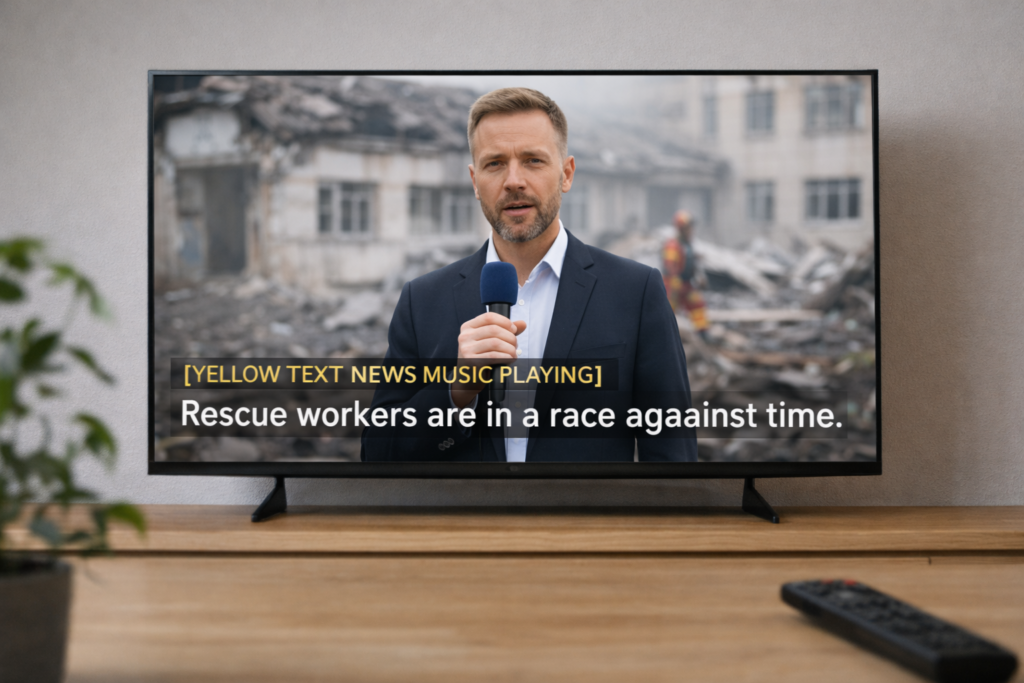
Subtitles are text shown mostly at the bottom of TV programs and videos. They are here for deaf and hard-of-hearing people to understand what is being said. In the European Union (EU), there are laws to make sure more videos have subtitles.
What Are Subtitles?
Subtitles show the words people are saying on screen. Special subtitles for deaf people also include:
- Information about sounds (like “door creaking” or “phone ringing”)
- Different colors to show who is speaking
- Notes about music or tone of voice
These special subtitles are sometimes called “subtitles for the deaf and hard-of-hearing” or SDH.
Why Subtitles Are Important
In the EU, 34.4 million adults have hearing problems that affect their daily life[1]. Without subtitles, these people cannot fully enjoy TV shows, news, and online videos. Subtitles help deaf people:
- Get important information
- Enjoy entertainment
- Feel included in society
- Learn new things
EU Laws About Subtitles
- All TV channels to add subtitles to their programs
- Streaming services (like online video platforms) to provide subtitles
- Websites to make their videos accessib
Different countries have different rules right now. For example:
- In the Netherlands, public TV channels must add subtitles to 95% of Dutch programs, while commercial channels must add subtitles to 50%[4]
- Some countries have better accessibility rules than others. This means that in some places, deaf people have more difficulty getting information.
Problems That Still Exist
Many deaf people still face challenges:
- Not all programs have subtitles yet
- Some subtitles are not good quality, have mistakes or are just a summary of what is said.
- Live programs are harder to subtitle correctly
- In countries like Slovakia, TV stations do not always follow the the rules[6].
The Future of Subtitles
By 2025, the situation should improve. The EU is working to make sure:
This will help the 22.6 million people in the EU who live with untreated hearing loss[1] to better access information and entertainment.
Where to Find support
If you watch a program without subtitles, you can:
- Contact the TV channel or video service
- Use the help desks that TV stations must provide for questions and complaints[7]
- Tell organizations that support deaf people about the problem
Subtitles are your right. The EU is working to make sure everyone can access and enjoy all media content.
Citations:
- https://www.efhoh.org/hearing-loss-numbers-and-costs/
- https://www.interprefy.com/resources/blog/european-accessibility-act-captioning-requirements
- https://www.ai-media.tv/knowledge-hub/insights/european-accessibility-act-2025/
- https://www.rijksoverheid.nl/binaries/rijksoverheid/documenten/kamerstukken/2023/07/06/antwoord-op-vragen-over-artikel-ondertiteling-voor-slechthorenden-ontbreekt-vaak/antwoord-op-vragen-over-artikel-ondertiteling-voor-slechthorenden-ontbreekt-vaak.pdf
- https://fra.europa.eu/en/content/are-there-legal-accessibility-standards-public-and-private-audiovisual-media
- https://www.sospotrebitelov.sk/sos/televizie-nerobia-co-maju-tvrdia-zrakovo-a-sluchovo-postihnuti/
- https://www.edf-feph.org/audio-visual-media-services-directive-avmsd-has-it-made-progress-for-media-accessibility/
- https://www.captionhub.com/blog-post/eaa2025/