

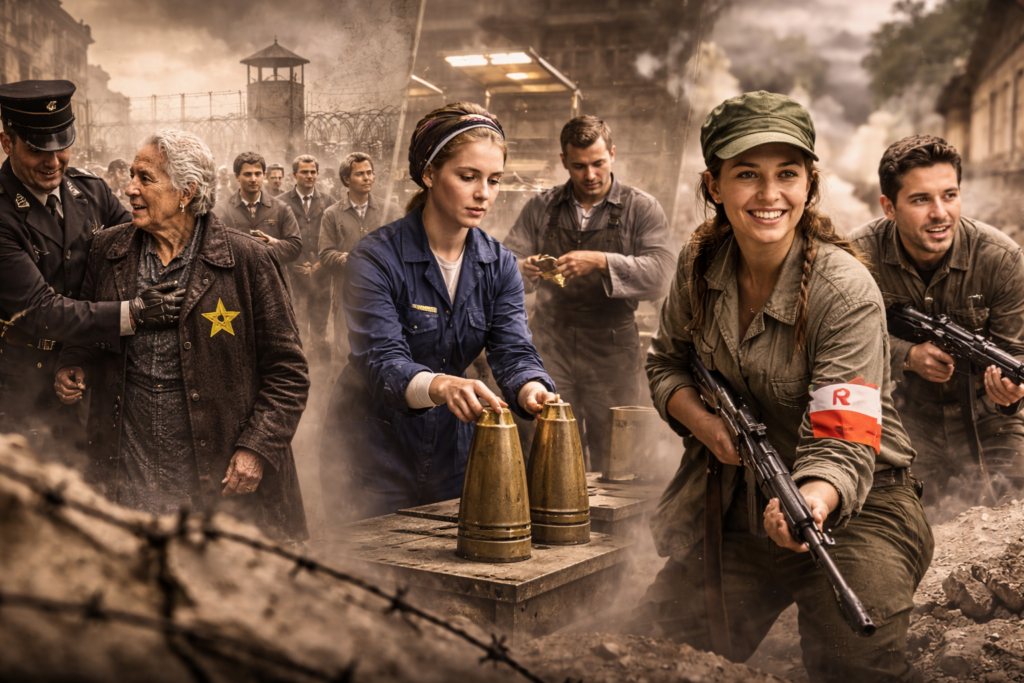
World War II (1939–1945) was a very difficult time for deaf people in Europe. Many faced unfair treatment, dangerous situations, and big changes to their everyday lives. Here is what happened in different European countries.
Germany and Nazi-Occupied Europe
- The Nazi government believed deafness was a “hereditary defect,” something wrong in families that could not be changed.
- Around 17,000 deaf people, including children as young as nine, were forced to have sterilization so they could not have children. This also happened in some other European countries[1][2].
- Many deaf Jewish people suffered the most. For example, out of about 600 deaf Jews in Berlin before the war, only 34 survived.
- Some deaf people in Germany joined the Nazi party at first, but later their own group, the Reich Union of the Deaf, was closed by Nazi leaders[1][2].
United Kingdom
- Deaf men and women worked in factories making important equipment like shells and tools for the military. This helped the country a lot during the war[1][3].
- Some deaf people joined the army. Harry Ward served with the Royal Munster Fusiliers, and Gomer Jones became a well-known marksman even though he was deaf and had only one good eye.
- Deaf people sometimes faced danger. Some were shot by soldiers because they could not hear commands to stop[1][3].
- Important events for deaf people, like the International Deaf Games in Sweden (1939), were stopped because of the war[3].
Poland
- During the Warsaw Uprising in 1944, a special group of about 30 deaf men and women fought alongside others. They built barricades, carried messages, and helped guard the city.
- After the war, deaf groups in cities like Łódź, Warsaw, and Silesia formed the Polish Association of the Deaf (1946). They worked to support deaf people with education, social services, and sign-language classes[2].
Netherlands
- Nearly 700 Jewish deaf people from Amsterdam were taken away and none came back. This was a big loss for the Dutch Deaf community—it meant there were few leaders left after the war.
- Today, a special memorial in Amsterdam remembers the deaf people who were lost.
- After the war, new deaf associations worked to help people with education and jobs[2].
Other Countries in the EU
- In Flanders (northern Belgium), many deaf people tried to survive under very hard conditions. Some lost their homes, jobs, or even their lives[4].
- In Hungary, deaf people were also at risk, especially those who were Jewish. They lost contact with Deaf schools and organizations, which closed or were taken over by the government. Some were sent to forced-labor camps or ghettos[2].
- In France, deaf people faced discrimination and some could not attend regular schools. Community life was much harder during the war[5][2].
- In Slovakia and other countries, deaf people sometimes had to move to avoid problems or find help, but it was difficult because of the fighting and changing borders[2].
Challenges for Deaf People
- Communication: Important warnings (like air raids) were often alarms or announcements that deaf people could not hear. This put them in danger.
- Moving to Safety: Some countries did not allow deaf refugees to enter, thinking they would need too much help.
- Community Life: Deaf clubs and sports events stopped. Many people lost touch with their friends and community.
- Some schools for the deaf had to close or take a break during the war for safety reasons. In other places, the school buildings were used for military purposes, such as housing soldiers or serving as temporary hospitals.
After the War
- Some hospitals in Europe opened special centers to help soldiers who lost hearing in the war.
- Deaf people and their families started to share their stories, which helped others understand their experiences.
- New clubs and groups for deaf people began, giving more support with school, work, and everyday life[1][2][5].
World War II was a time of suffering and change for deaf people, but many showed great courage. After the war, new support and recognition helped deaf communities to become stronger all across Europe.
Citations:
- https://deafhistory.eu/index.php/component/zoo/item/1940-1945-world-war-ii
- https://www.rit.edu/deafww2/sites/rit.edu.deafww2/files/documents/DeafPeopleinHitlersEurope.pdf
- https://www.historic-uk.com/HistoryUK/HistoryofBritain/The-Scarce-Heard-The-Deaf-Experience-Of-War/
- https://www.degruyterbrill.com/document/doi/10.1515/9783110701906-009/html
- https://en.wikipedia.org/wiki/Deafness_in_France