

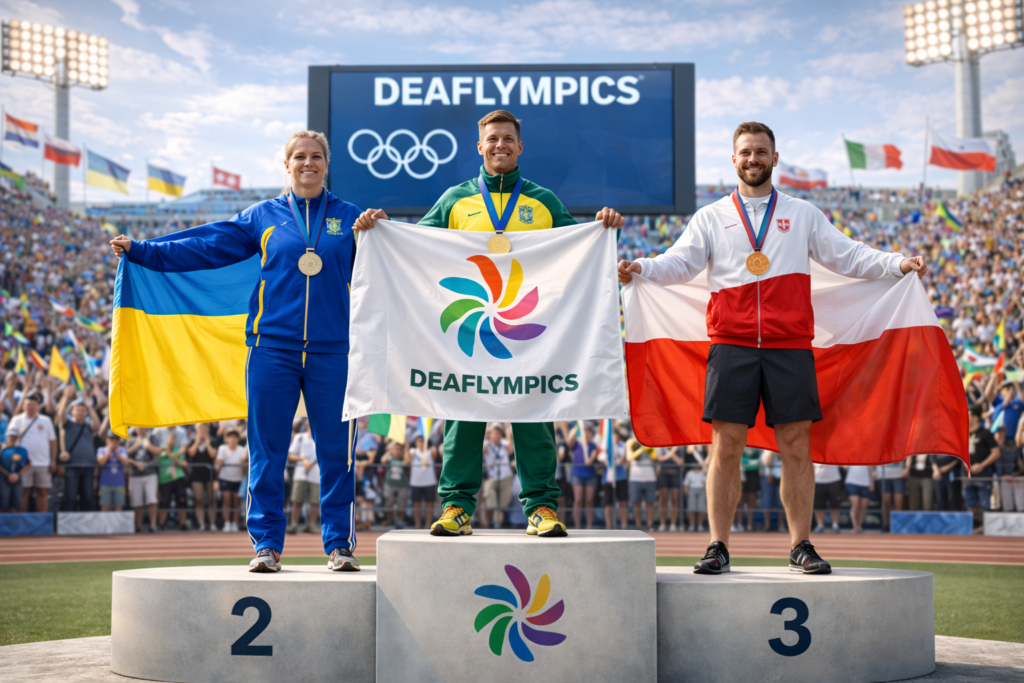
The Deaflympics are international sports events for deaf athletes. They started in 1924 and are organized by the International Committee of Sports for the Deaf (ICSD)[1][2]. Unlike the athletes at the Olympics, athletes here cannot hear sounds like starters’ guns, so events use visual signals[3][4]. This report explains the Deaflympics’ history, rules, and examples from Europe.
History of the Deaflympics
The first Deaflympics took place in Paris in 1924 with 148 athletes from nine countries[1][4]. It was the first international sports event for people with disabilities. The games were called the “International Silent Games” or “International Games for the Deaf,” then the “World Games for the Deaf” until 2001, when they became the Deaflympics.[4]. The ICSD, founded in 1924, manages these games and works with the International Olympic Committee (IOC)[2][5].
How Deaflympics Work
Deaf athletes must have hearing loss of at least 55 decibels in their better ear[6][4]. Events use lights instead of sounds. For example, in athletics, a starting light flashes red, yellow, and green to signal runners when to begin[3]. This ensures fair competition. Sports include different sports, like football, swimming, and cycling, similar to the Olympics[7][8].
European Participation
Europe has a strong role in Deaf sports. The European Deaf Sport Organization (EDSO), started in France in 1983, helps organize championships[9]. The Netherlands joined the first Deaflympics in 1924. Heiny van der Heijden, a Dutch female swimmer, won gold in 1924 despite competing against men[10]. Slovakia has also succeeded. In 2013, Slovak athlete Ivana Krištofičová won gold in shot put and silver in discus throw[11].
Recent Events and Future
Conclusion
The Deaflympics show how sports can adapt for equality. With visual signals and inclusive rules, deaf athletes compete fairly. European countries like the Netherlands and Slovakia have rich histories in these games. The future looks bright, with more nations joining every year.
Citations:
- https://currentaffairs.adda247.com/deaflympics-2022/
- https://www.deaflympics.com/icsd
- https://deaflympics2025-games.jp/en/main-info/sports/athletics/
- https://en.wikipedia.org/wiki/Deaflympics
- https://deafsport.be/international-committee-of-sports-for-the-deaf
- https://www.deaflympics.com/icsd/deaflympics-regulations
- https://www.deaflympics.com/sports
- https://deaflympics2025-games.jp/en/main-info/sports/
- https://deafsport.be/european-deaf-sport-organization
- https://www.kndsb.nl/107559/100-jaar-deaflympics-1924-2024
- https://www.teraz.sk/sport/deaflympiada-sofia-medaily/54542-clanok.html
- http://www.deaflympics.com/pdf/team-sports-qualification.pdf
- https://www.deaflympics2025.com/en/icsd