

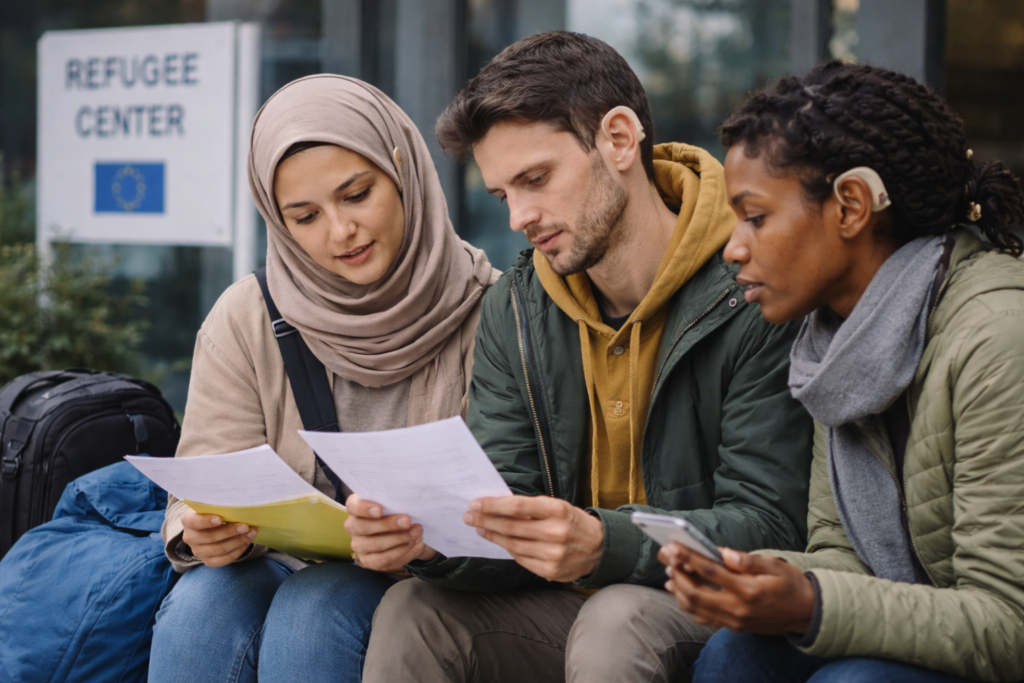
Deaf refugees are people who are deaf and had to leave their home country because of war or danger. They face challenges when they come to new countries in Europe. They often do not know the sign language of their new country and need support to communicate.
Who are deaf refugees?
Deaf refugees are people who:
- Are deaf or hard of hearing
- Have fled their home country because of war, violence, or persecution
In their original country, they may have had limited or no formal education.
After arriving in a new country, they often face additional challenges, such as:
- Learning a new sign language
- Feeling isolated or alone
Since the war in Ukraine began in 2022, many deaf refugees have arrived in Europe seeking safety and support.
Why war is especially dangerous for deaf people
In war zones, deaf people face extra risks:
- They cannot hear air raid sirens or emergency announcements
- They may not know what is happening if there is no visual information
- Communication during evacuation is difficult without interpreters or sign language users
One deaf refugee from Ukraine said:
“When air raid sirens sound, I cannot hear them. I was asleep when the war started and did not hear the sirens.”
Why deaf refugees need extra support
After fleeing, deaf refugees face new challenges that hearing refugees often do not:
- They cannot easily communicate with services; many cannot speak or write in English
- They need sign language interpreters who understand the sign language of their home country
- Most refugee services do not offer sign language support
- Without communication, they may feel isolated or unsafe
That’s why deaf refugees need accessible information, qualified interpreters, and deaf-aware support in their new country.
Support for deaf refugees in Europe
The European Union knows that deaf refugees need special help. Many countries have created programs to help:
Sign language interpretation
In Poland, an organization called Migam provides 24/7 video sign language interpretation for deaf Ukrainian refugees[4]. This helps deaf refugees talk to doctors, government workers, and others.
In Slovakia, the Association of the Deaf offers:
- Ukrainian sign language interpretation online and in-person
- Information videos in Ukrainian sign language
- A Ukrainian-Slovak sign language dictionary[5]
Education and integration
In Switzerland, an organization called DIMA helps deaf refugees learn:
- Swiss German Sign Language
- Written German
- Computer skills
- How to find jobs
Special accommodation
In Austria, the Hospital St. John of God Linz has helped 47 deaf Ukrainian refugees by:
- Finding places for them to live
- Organizing German and Austrian Sign Language courses
- Working with deaf support groups[6]
Netherlands: The deaf club Swedoro in Rotterdam has helped deaf Ukrainian refugees by:
- Providing housing support
- Helping arrange access to health care and social services
- Organizing activities and building community connections
Where to find help
If you are a deaf refugee or know someone who is, there is help available:
- The European Union of the Deaf also offer to a deaf refugee for Ukraine war: https://eud.eu/policy/human-rights/information-for-deaf-refugees-from-ukraine/
- The World Federation of the Deaf is collecting money to help deaf refugees from Ukraine. You can donate to support them[11][8] and you can also find more information: https://wfdeaf.org/refugeesukraine/
Remember
If you are a deaf refugee, you have the right to:
- Ask for sign language interpreters at official meetings
- Get information in sign language
- Get special support for your needs
- Connect with the deaf community in your new country
Many people and organizations want to help deaf refugees feel welcome and included in their new homes.
Citations:
- https://globalcompactrefugees.org/good-practices/communication-education-and-integration-deaf-refugees
- https://euaa.europa.eu/sites/default/files/publications/2024-01/2024_persons_with_disabilities_asylum_reception_en_0.pdf
- https://www.european-agency.org/news/hearing-situation-refugees-and-migrants-disabilities
- https://www.rescue.org/eu/article/meet-oleksii-and-roman-interpreters-helping-deaf-ukrainian-refugees
- https://help.unhcr.org/slovakia/association-of-the-deaf-of-slovakia/
- https://zeroproject.org/view/project/99cf1df0-e308-449c-bc47-97e716f667fb
- https://www.eud.eu/policy/human-rights/information-for-deaf-refugees-from-ukraine/sweden/
- https://wfdeaf.org/refugeesukraine/
- https://www.deafrefugees.de
- https://www.refugeehelp.nl/en/ukrainian-refugee/article/100098-care-for-people-with-disabilities
- https://www.eud.eu/policy/human-rights/information-for-deaf-refugees-from-ukraine/