

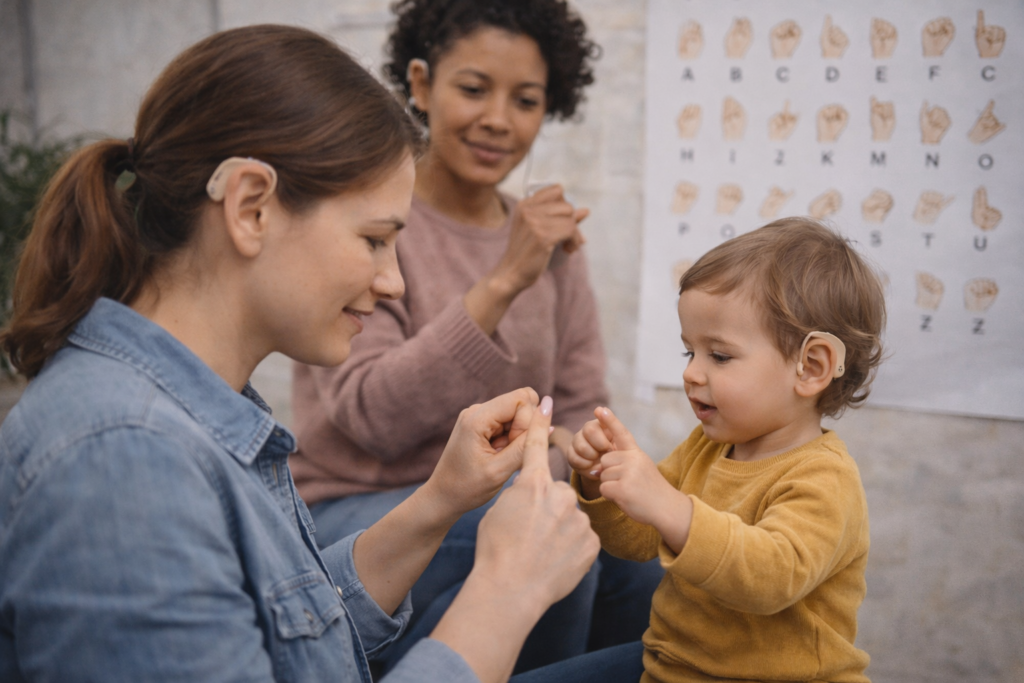
What is Sign Language?
Sign language is a visual language used by Deaf people. It is a complete language with its own grammar, vocabulary, and structure. Sign language uses hand movements, hand shapes, and facial expressions to communicate. Each country has its own sign language.
How Do People Learn Sign Language?
From Birth: Deaf children with deaf parents learn sign language naturally from birth. This is like how hearing children learn spoken language at home.
Later in Life: Most deaf children (about 90%) have hearing parents who do not know sign language. These children may learn sign language when they start school. Learning sign language early is important for communication and brain development.
Learning Stages
Baby Stage (6-12 months): Babies learning sign language “babble” with their hands. They play with hand shapes and movements.
First Signs (8-12 months): Children start using simple signs like “eat,” “drink,” or “play.” First signs appear around 8.5 months, earlier than first spoken words[1].
Building Sentences (18-24 months): Children combine signs into sentences. Two-sign combinations appear around 16-17 months.
Fluency (2-3 years): Children become fluent and can express complex ideas.
Why is Early Learning Important?
Studies show that learning sign language early helps deaf children:
- Perform better in school
- Read texts more easily
- Develop stronger thinking skills
- Have better social skills
Research shows that deaf students who learn sign language from preschool age have higher academic success than those who learn it later[2].
Sign Language in Europe
Europe has more than 30 national and regional sign languages. Each country has its own:
- British Sign Language (BSL) in the UK
- French Sign Language (LSF) in France
- Slovak Sign Language (SPJ) in Slovakia
- Dutch Sign Language (NGT) in the Netherlands
Challenges
Many deaf children cannot learn sign language early enough. Late learning can cause lasting problems with language development. The first few years of life are most important for language learning[4].
Support for Learning
To help more children learn sign language:
- Schools should teach sign language
- Parents should learn sign language with their children
- Governments should recognize sign languages as official languages
Research shows that learning sign language does not hurt spoken language developement[5].
Conclusion
Sign languages are important for Europe’s diversity. This is how deaf people communicate. Early access to sign language gives deaf children the best foundation for future learning.
Citations:
- https://pubmed.ncbi.nlm.nih.gov/6661942/
- https://academic.oup.com/jdsde/article/21/4/394/2452823?login=false
- https://knowledge-centre-translation-interpretation.ec.europa.eu/en/news/sign-languages-raising-awareness-and-inclusion-local-and-international-level
- https://scispace.com/pdf/the-critical-period-for-language-acquisition-and-the-deaf-zvtgxfwsun.pdf
- https://lillomartin-linguistics.media.uconn.edu/wp-content/uploads/sites/1112/2016/11/Davidson_et_al_2014_JDSDE_f.pdf