

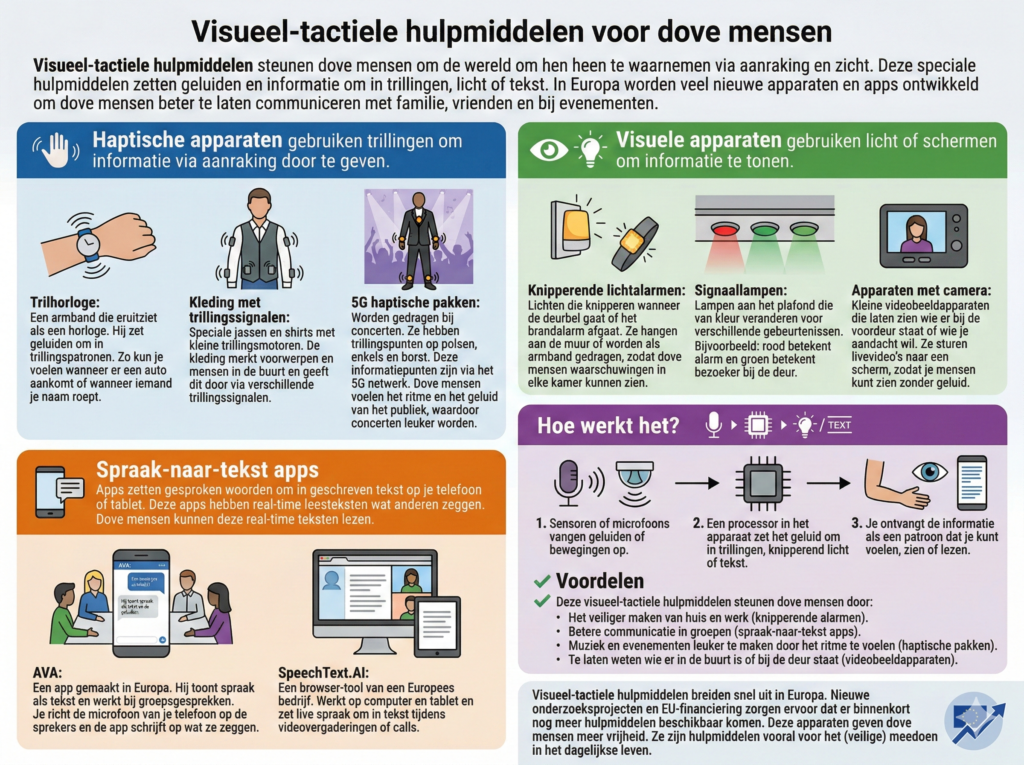
Visual-tactile technology supports deaf people to understand their world through touch and sight. These special tools turn sounds and information into vibrations, lights, or text. In Europe, many new devices and apps are made to support deaf people to connect better with family, friends, and events.
Haptic Devices
Haptic devices use vibrations to give information through touch.
- Neosensory Buzz: A wristband that looks like a watch. It changes sounds into vibration patterns so you can feel when a car is coming or when someone calls your name.
- SUITCEYES clothing: Special jackets and shirts with tiny vibrating motors. The clothes sense objects and people nearby and tell you through different vibration signals.
- 5G haptic suits: Worn at music concerts, these suits have vibration points on the wrists, ankles, and chest. They let deaf people feel the beat and crowd noise, making concerts more fun.
Visual Devices
Visual devices use lights or screens to show information.
- Flashing light alarms: Lights that flash when the doorbell rings or the fire alarm goes off. These lights are placed on walls or worn as bracelets so deaf people can see alerts in any room.
- Signal lamps: Ceiling lamps that change color for different events. For example, a red lamp can mean alarm, and a green lamp can mean visitor at the door.
- Camera monitors: Small video devices that show who is at the front door or who wants your attention in a room. They send real-time video to a screen, so you can see people without hearing a doorbell.
Speech-to-Text Apps
Apps turn spoken words into written text on your phone or tablet. These apps supports deaf people reading what others say in real time.
- AVA: An app made in Europe. It shows speech as text and works in group conversations. You point your phone’s microphone at speakers, and the app writes what they say on the screen.
- SpeechText.AI: A browser tool from an EU company. It works on computers and tablets, turning live speech into text during video calls or meetings.
How It Works
- Sensors or microphones pick up sounds or movements.
- Processor inside the device changes the sound into vibrations, flashing lights, or text.
- Feedback is sent to you as a pattern you can feel, see, or read.
Benefits
These visual-tactile tools supports deaf people by:
- Making home and work safer (flashing alarms).
- Improving communication in groups (speech-to-text apps).
- Letting you enjoy music and events by feeling the beat (haptic suits).
- Letting you know who is nearby or at the door (camera monitors).
Visual-tactile technology is growing fast in Europe. New research projects and EU funding ensure more tools will be available soon. These devices give deaf people more freedom and support them to join daily life with confidence.