

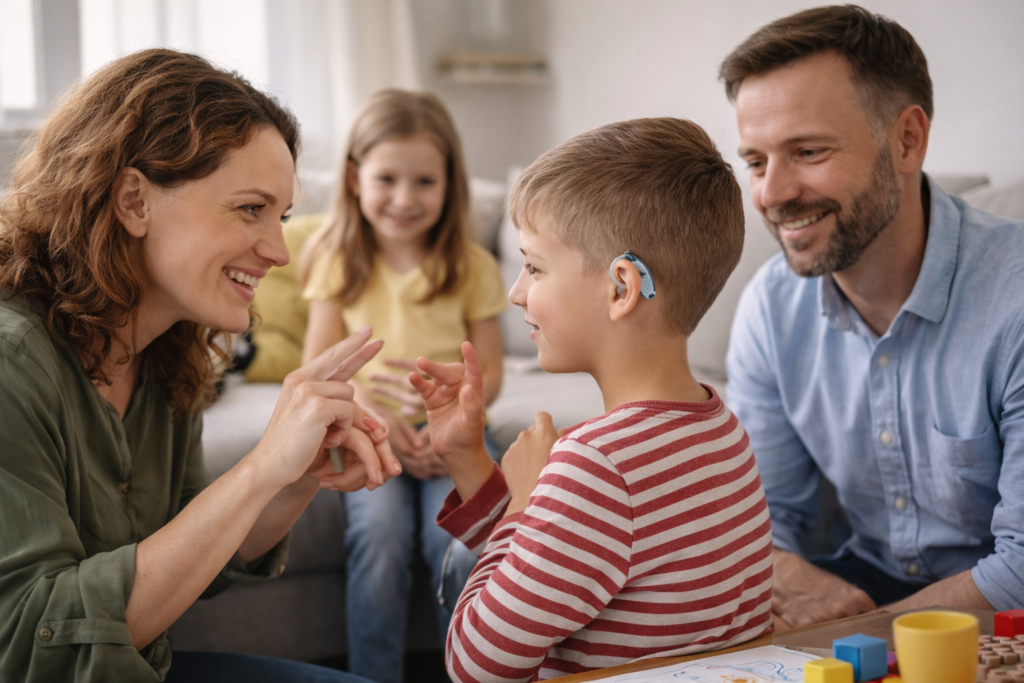
Most deaf children (over 90%) grow up in families where parents are hearing. These families often know little about deafness. It is normal to have many questions. This article explains key ideas and offers simple tips.
Deafness and Communication
A deaf child cannot hear sounds in the usual way. Deafness has many levels. Some children use hearing aids or cochlear implants, and many also use sign language. It’s not an either/or situation — there are different ways to communicate and experience sound. Every child is unique and needs the right support.
Learning Sign Languagee
Sign language uses hand shapes, movements and facial expressions. It is a complete language. Learning simple signs helps everyone talk together. For example:
- Play
- Mom, dad, friend
Parents can start with small groups or/and online courses. Brothers, sisters and grandparents can join too. This builds a strong support circle.
Using Visual and Tactile Cues
Visual and touch cues make meaning clear:
- Point to objects when naming them.
- Show pictures and use cards with images.
- Use gentle taps on the shoulder to gain attention.
Each cue gives a clear signal without sound. This helps deaf children follow daily routines.
Building an Inclusive Home
Families can make the home friendly for deaf children:
- Place bright lights near faces to help lip-reading.
- Keep rooms clear of noise and distractions.
- Use mirrors so the child sees your face when you talk.
These small changes make it easier for the child to join in conversations.
Finding Support in Europe
Across Europe, many groups help hearing families:
- FEPEDA (European Federation of Parents of Hearing Impaired Children) offers meetings, newsletters and online resources.
- SILENT Project provides free e-learning, videos of basic signs and an inclusive picture book in six languages.
- Local parent groups and special education centres can offer face-to-face workshops.
Joining a network connects families with similar experiences. It builds confidence and shares useful advice.
Making Playtime Fun and Fair
Playtime should be equal for all children:
- Choose games that use sight and touch, like puzzles or block building.
- Plan group activities that include everyone, for example drawing or simple board games.
- Encourage friends to learn a few signs before visits.
Inclusive play helps deaf children feel part of the group and reduces loneliness.
Working with Schools and Therapists
Early help is best. Many countries in Europe offer free early intervention services. These teams may include speech therapists, sign-language teachers and social workers. Parents should:
- Ask about rights under European laws (for example, the UN Convention on the Rights of Persons with Disabilities).
- Keep clear records of meetings and progress.
- Speak up for the child’s rights and needs.
A child learns best when parents, teachers and therapists work together.
Key Points to Remember
Deaf children thrive when families use clear signs, visual cues and inclusive activities. Joining support groups in Europe gives practical tools and friendship. Simple changes at home make daily life richer for the child. With love, patience and teamwork, deaf children in hearing families can grow, learn and succeed.
Citations:
- https://www.mdpi.com/1648-9144/59/7/1354
- https://pmc.ncbi.nlm.nih.gov/articles/PMC7225570/
- https://cuedspeech.eu/en/about/
- https://library.parenthelp.eu/wp-content/uploads/2024/08/SILENT-Family-Learning-Toolkit.pdf
- https://theconversation.com/deaf-a-powerful-film-about-the-real-struggles-of-deaf-families-navigating-medical-institutions-and-parenthood-265013
- https://www.eud.eu/wp-content/uploads/2021/11/EUD_UNCRPD_IV.pdf
- https://www.eud.eu/wp-content/uploads/2022/03/EUD-Position-Paper-Inclusive-Education.pdf
- https://fepeda.eu
- https://saltoinclusion.eu/wp-content/uploads/2023/05/ESN_Inclusive_Communication_Manual-1.pdf
- https://www.edf-feph.org/our-members/european-federation-of-parents-of-hearing-impaired-children-fepeda/
- https://www.cambridge.org/core/journals/continuity-and-change/article/deaf-and-unwanted-marriage-characteristics-of-deaf-people-in-eighteenth-and-nineteenthcentury-belgium-a-comparative-and-crossregional-approach/45A651AD7D094201278DC4CF5BF00C31
- https://www.mdpi.com/2039-4349/15/1/10
- https://comm4child.ulb.be
- https://fepeda.eu/mission/
- https://journals.sagepub.com/doi/abs/10.1177/0192513X211038074
- https://www.alda-europe.eu/wp-content/uploads/2024/10/Revised-Inclusive-Communication-Toolkit-3_compressed.pdf
- https://fepeda.eu/federal-parents-association-of-deaf-children-e-v-2/
- https://www.deafcenter.lt/wp-content/uploads/2021/03/INCLUSIVE-SETTINGS-2021-J-CRAIG.pptx
- https://www.ecml.at/en/ECML-Programme/Programme-2024-2027/DeafSign
- https://www.uni-siegen.de/zew/insign/outcomes/communication_challenges/files/final_cy_report_-insign.pdf
- https://parentsinternational.org/supporting-parents-of-deaf-children/
- https://www.cureus.com/articles/315725-support-desired-by-parents-of-infants-with-hearing-impairments-diagnosed-through-newborn-hearing-screening-a-questionnaire-based-survey
- https://onlinelibrary.wiley.com/doi/pdfdirect/10.1111/hex.13864
- https://www.frontiersin.org/articles/10.3389/fpsyg.2024.1315220/full
- https://europepmc.org/articles/pmc3663287?pdf=render
- https://pmc.ncbi.nlm.nih.gov/articles/PMC8949393/
- https://pmc.ncbi.nlm.nih.gov/articles/PMC10686551/
- https://epale.ec.europa.eu/en/blog/silent-project-families-deaf-children