

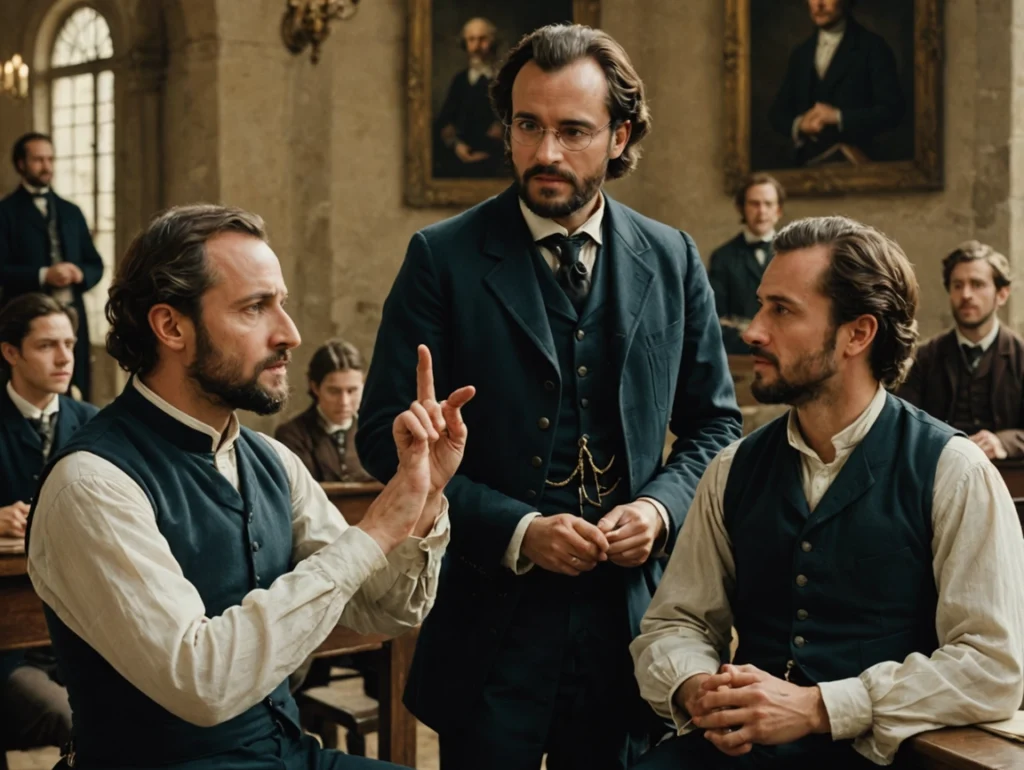
This article explains important people in deaf history. These individuals created new ways to teach deaf people, fought for their rights, and helped shape sign languages. Their work laid the foundation for modern Deaf education and community pride.
Charles-Michel de L’Épée (1712–1789)
Charles-Michel de L’Épée, often called the “Father of the Deaf,” started the first free school for deaf students in Paris in 1760[1][2][3]. Before his school, only wealthy families could afford private tutors for their deaf children. L’Épée believed everyone deserved education, regardless of money. He used an early form of sign language to teach French and religion, helping students communicate fully[4][5]. His methods spread globally, inspiring schools worldwide[6].
Jacob Rodrigues Pereira (1715–1780)
Jacob Rodrigues Pereira, a Portuguese Jewish teacher, developed hand signs for numbers and sounds in the 1700s[7][8]. He taught deaf children to read and write by linking hand movements to letters[9]. His work showed that deaf people could learn complex ideas, challenging myths about their abilities. Pereira also fought for Jewish rights in France, connecting his advocacy for education and equality[8][10].
Ferdinand Berthier (1803–1886)
Ferdinand Berthier, born deaf, became a leader in the Deaf community. He co-founded the first Deaf rights organization in 1838 and organized gatherings to build community pride[11][12]. Berthier promoted bilingual education (sign language and written French) and wrote books about famous deaf people to highlight their achievements[11][13]. His work helped deaf people gain respect and opportunities in society.
Pedro Ponce de León (1508–1584)
Pedro Ponce de León, a Spanish monk, was one of the first to teach deaf students in the 1500s[14]. He used hand gestures and writing to help them communicate, proving that deaf individuals could learn language. His methods influenced later educators.
Juan de Pablo Bonet (1573–1633)
Laurent Clerc (1785–1869)
Why These Figures Matter
These pioneers showed that deaf people could learn, work, and contribute to society. They challenged stereotypes and created tools for communication. For example:
- Sign language became a bridge for education and culture.
- Schools provided safe spaces for deaf students to grow.
- Advocacy led to better laws and respect for Deaf rights.
Today, their legacies live on in bilingual schools, sign language recognition, and deaf-led organizations. By learning their stories, we honor their fight for equality and inclusion.
This article uses information from European historical records and institutions. Visual examples, like comparing sign language to hand gestures used daily, help explain complex ideas simply.
Citations:
- https://fr.wikipedia.org/wiki/Charles-Michel_de_L‘%C3%89p%C3%A9e
- https://en.wikipedia.org/wiki/Charles-Michel_de_l‘%C3%89p%C3%A9e
- https://www.injs-paris.fr/page/patrimoine-et-culture/histoire-injs-paris/personnalites-du-monde-de-la-surdite/charles-michel-de-lespee-dit-labbe-de-lepee-1712-1789/
- https://www.herodote.net/Providence_des_sourds-synthese-1764.php
- https://numerabilis.u-paris.fr/medica/bibliotheque-numerique/presentations/orl/j.php
- https://publictionnaire.huma-num.fr/notice/de-lepee-charles-michel/
- https://en.wikipedia.org/wiki/Jacob_Rodrigues_Pereira
- https://fr.wikipedia.org/wiki/Jacob_Rodrigue_Pereire
- https://fr.wikipedia.org/wiki/Frères_Pereire
- https://fr.wikipedia.org/wiki/Lumières_portugaises
- https://www.eduyush.com/blogs/career-advice/ferdinand-berthier
- https://fr.wikipedia.org/wiki/Ferdinand_Berthier
- https://fr.wikipedia.org/wiki/Laurent_Clerc
- https://es.wikipedia.org/wiki/Pedro_Ponce_de_León
- https://es.wikipedia.org/wiki/Juan_de_Pablo_Bonet
- https://de.wikipedia.org/wiki/Samuel_Heinicke