

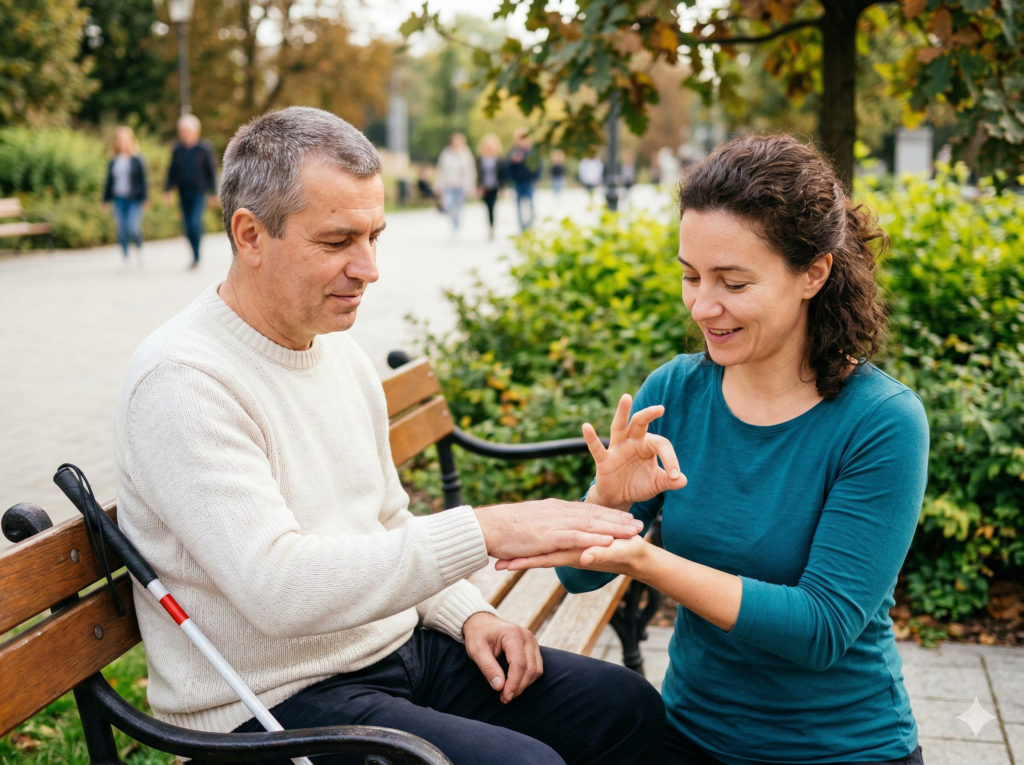
DeafBlindness is when a person has both vision and hearing problems. It is not just being deaf plus being blind. It is its own special disability. Most DeafBlind people have some hearing or vision left, but they are still DeafBlind.
How many people are DeafBlind?
What causes DeafBlindness?
Some people are born DeafBlind. This can happen because of:
- Problems during birth before 37 weeks of pregnancy
- Infections before birth like rubella (German measles)
- Genetic conditions like CHARGE syndrome
- Brain problems that affect movement[4]
Other people become DeafBlind later in life. This can happen because of:
- Usher syndrome, which is a rare genetic condition. People are born with hearing loss or lose their hearing when they are young, and later they also lose vision because of an eye problem called retinitis pigmentosa.
- Getting older, which can slowly reduce both hearing and vision.
- Eye problems like cataracts or glaucoma.
- Diabetes that damages the eyes.
- Brain injury from accidents or illness. [4]
How do DeafBlind people communicate?
DeafBlind people can use touch to communicate. Many use tactile sign language. This means they feel the signs with their hands[5]. A DeafBlind person puts their hands on top of the signer’s hands to feel the movements.
When DeafBlind people from different countries meet, they use tactile International Sign. This is a special way to communicate across languages[5].
What support do DeafBlind people need?
DeafBlind people need special help:
- Interpreting of speech – changing spoken words into tactile signs or clear speech[6]
- Environmental description – explaining what is happening around them, who is there, and the feeling of the room[6]
- Guiding – help with moving around safely[6]
This support helps DeafBlind people to join in activities and be part of society.
DeafBlindness as a unique disability
In 2004, the European Union recognized DeafBlindness as a separate disability[7]. Eight European countries now accept this: Denmark, France, Sweden, UK, Romania, Italy, Spain, and Austria[8]. This is important because DeafBlind people need different support than people who are only deaf or only blind.
Being part of the Deaf community
Many DeafBlind people were part of the Deaf community before losing their vision. They may have grown up using sign language. When they start to lose vision, they learn to use tactile signing instead of visual signing[5].
DeafBlind people are an important part of the diverse Deaf community. They show us how people can adapt and find new ways to connect with others.
Citations:
- https://siketvak.hu/wp-content/uploads/2014/07/Final-Report-Deafblind-Indicators.pdf
- https://helenkeller.nl
- https://www.annesullivan.ie/advice-information/how-common-is-deafblindness/
- https://www.nhs.uk/conditions/deafblindness/causes/
- https://www.universiteitleiden.nl/sign-languages/projects/emerging-tactile-international-sign-in-europe
- https://wfdb.eu/interpretation/
- https://www.deafblindinternational.org/european-deafblind-network-edbn/
- https://www.annesullivan.ie/advice-information/deafblindness-as-a-distinct-disability/