

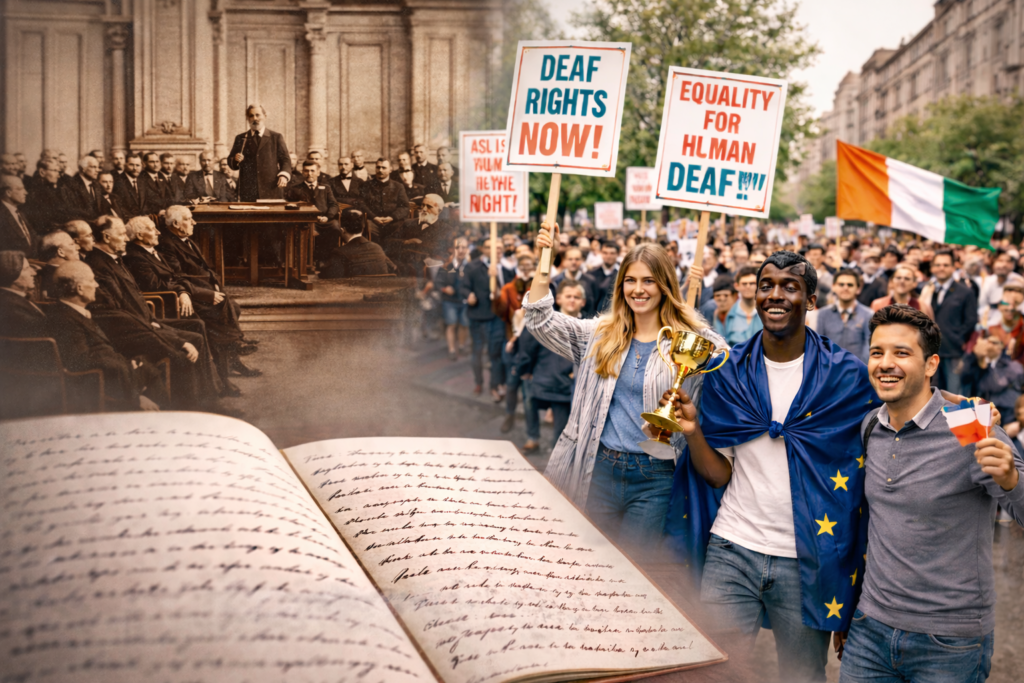
Emancipation means gaining freedom and equal rights after unfair treatment. For deaf people, emancipation encompasses equal education, fair work opportunities, and recognition of sign languages and Deaf culture.
Early Challenges
In the 19th century, deaf people faced severe barriers. Many schools banned sign language and enforced oralism—teaching lip-reading and speech only. At the Second International Congress on Education of the Deaf in Milan in 1880, educators passed resolutions declaring oral education superior and banning sign language in schools[1]. This “Dark Age” of Deaf education persisted until the late 1960s.
Deaf adults were restricted to practical, low-skilled jobs despite their abilities. Social isolation and exclusion from public life left Deaf communities voiceless.
Rise of the Emancipation Movement
In 1951, delegates from 25 national deaf associations founded the World Federation of the Deaf (WFD) in Rome to advocate for human and linguistic rights of deaf people worldwide[2][3]. The WFD has since influenced the UN Convention on the Rights of Persons with Disabilities.
Activists campaigned for official recognition of sign languages and bilingual education, proving through research that sign languages possess full linguistic structure.
Key Legal Milestones
- Slovakia recognized Slovak Sign Language by law in 1995, declaring it the natural visual-movement language of deaf people and guaranteeing education in sign language[4][5].
- Slovenia passed the Law on the Use of Slovenian Sign Language in 2002, granting interpreter rights in education; in 2021, the constitution was amended to guarantee that Slovenian, Italian, and Hungarian sign languages, and the language of the Deafblind, receive constitutional protection[6][7]. Slovenia is the only country that has done this for the deafblind language.
- The Netherlands approved Dutch Sign Language (NGT) as an official language in October 2020, recognizing NGT alongside Dutch and Frisian and strengthening its legal status after decades of advocacy
Continuing Impact
Today, many European countries embrace bilingual education, combining sign and spoken languages. Deaf organizations host cultural events, sometimes to show artistic achievements. The Deaflympics celebrate athletic and artistic achievements. Emancipation has granted dignity, self-respect, and societal participation to deaf individuals.
Challenges Ahead
Not all countries officially recognize sign languages, and accessibility in workplaces and full bilingual curricula remain uneven. The fight continues for universal sign language rights and inclusive policies to ensure that deaf people get equal opportunities and respect.
The fight for universal sign language rights and truly inclusive policies is not over. Deaf communities and their allies must keep fighting and stay watchful, because the struggle for equal rights and respect is never finished.
Citations:
- https://en.wikipedia.org/wiki/Second_International_Congress_on_Education_of_the_Deaf
- https://wfdeaf.org/our-story/
- https://en.wikipedia.org/wiki/World_Federation_of_the_Deaf
- https://signteach.eu/index.php/slovakia
- https://deafhistory.eu/index.php/component/zoo/item/1995
- https://deafhistory.eu/index.php/component/zoo/item/2002-slovenia-legal-recognition-of-slovenian-sign-language
- https://www.gluhoslepi.si/en/slovenia-became-the-first-country-to-include-the-language-of-the-deafblind-in-the-constitution/
- https://deafhistory.eu/index.php/component/zoo/item/2020-legal-recognition-ngt-sign-language-of-the-netherlands
- https://en.wikipedia.org/wiki/Dutch_Sign_Language